Offline-First Mobile Architecture for Field Teams
Offline-first mobile architecture for field teams: local writes, honest sync UX, conflict policies, durable queues, and release habits crews can rely on without constant signal.
Field operators work in basements, warehouses, plants, and remote sites. If your mobile product only functions on strong Wi-Fi, it is an office app wearing a phone costume—and crews will revert to paper, texts, or spreadsheets the first time data disappears.
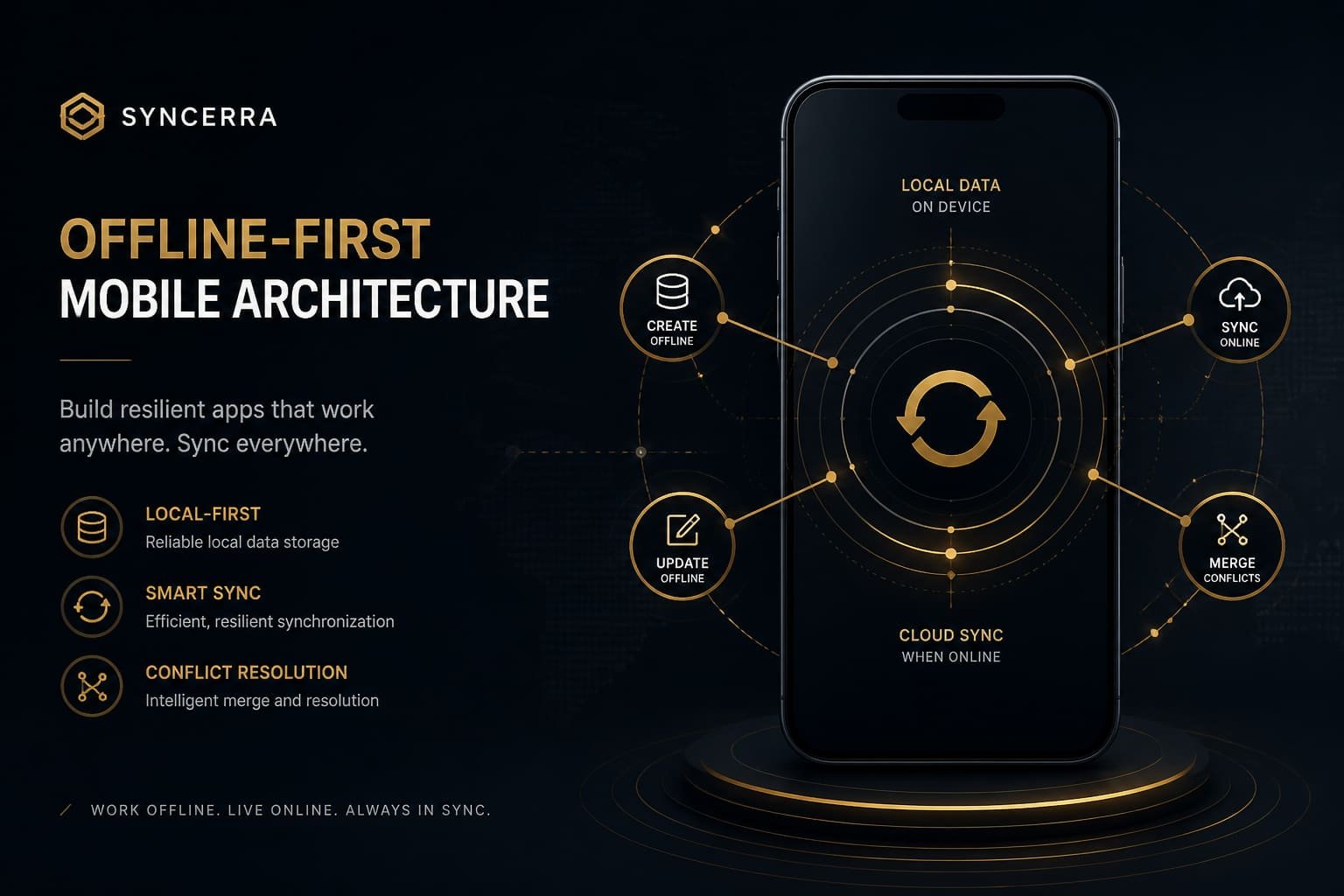
Offline-first architecture does not mean “works without server forever.” It means critical tasks can be completed locally, state survives restarts, sync progress is visible, and conflicts are handled with rules users understand—not silent overwrites.
Offline-first design principles
Design task flows around what must be doable with zero connectivity, what can wait, and what requires live confirmation from a system of record. Be explicit about that contract in UX and in engineering.
- Local write capability for critical tasks with durable on-device storage
- Sync status the user can read at a glance: pending, synced, failed, needs attention
- Conflict rules decided before launch—not debated in production for the first time
- Queues that survive app kills, OS updates, and intermittent background execution limits
Sync strategies that stay honest
Prefer explicit sync states over silent magic. Users should know what is pending, what failed, and what requires attention. Silent data loss destroys trust faster than a visible offline banner.
Batch uploads when connectivity returns, but avoid blocking the entire UI on a single large payload. Retry with backoff, surface partial failures, and let users fix or discard stuck items without reinstalling the app.
Conflict handling
Default policies should match business risk. Low-risk descriptive fields may tolerate last-write-wins. Financial quantities, inventory counts, and safety checklists need server authority or human resolution screens.
- Last-write-wins only for low-risk, non-financial fields
- Server authority for financial facts, inventory, and compliance checkpoints
- Human resolution screens for high-stakes collisions with context from both sides
Offline support is a product promise. If sync is unreliable, the promise is broken.
UX that keeps trust offline
Show pending, synced, and failed states on every screen where edits matter. Let users retry failed items individually. Never hide the fact that data has not reached the server—field teams will forgive limited connectivity; they will not forgive silent loss.
- Pending indicators on every unsent change and attachment
- Readable conflict screens with who changed what and when
- Local drafts and captured media that survive app restarts
- Battery-aware sync that avoids thrashing on weak networks
Engineering habits for field releases
Monitor sync failure rates, queue depth, and crash clusters by app version and region. Roll out to pilot crews before national deployment. Support paths should reach people who actually work on site—not only headquarters.
Version skew matters offline: older app builds may write shapes the server no longer accepts. Plan migration of local schemas and communicate forced upgrades when safety or compliance requires it.
How LucidNova builds field apps
We design task flows, offline behavior, and release habits together—so the app remains usable on real sites, not only in demos on office Wi-Fi.
Contact LucidNova Technologies · hello@lucidnovatech.com · Mumbai, Maharashtra, India