Mobile App Development for Field Operations Teams
Mobile app development for field operations: offline-first sync, task-first UX, proof capture, staged rollouts, and support paths field leads will actually use.
Field operators do not work like office users. Connectivity drops in basements and remote sites. Screens are used in glare and rain. Tasks must finish quickly because the next job is waiting. Mobile products that ignore those constraints become shelfware—installed once, then bypassed with calls and paper.
Successful field apps are designed around the job, not the feature catalog. That means offline-tolerant data paths, obvious sync status, and flows that assume interruption. When the phone is the workplace, reliability matters more than visual polish.
Design for the real workplace
Start with environmental constraints, not wireframes. Can the user complete the critical task with no signal? Can they see whether data reached the server? Can they recover from an app kill mid-form without losing proof? Those questions shape architecture more than brand colors.
- Offline-tolerant sync with explicit pending and failed states
- Large tap targets and high-contrast status cues for outdoor use
- Task lists that prioritize what must be done today
- Photo, location, and signature capture where the process needs proof
- Battery-aware sync that avoids thrashing on weak networks
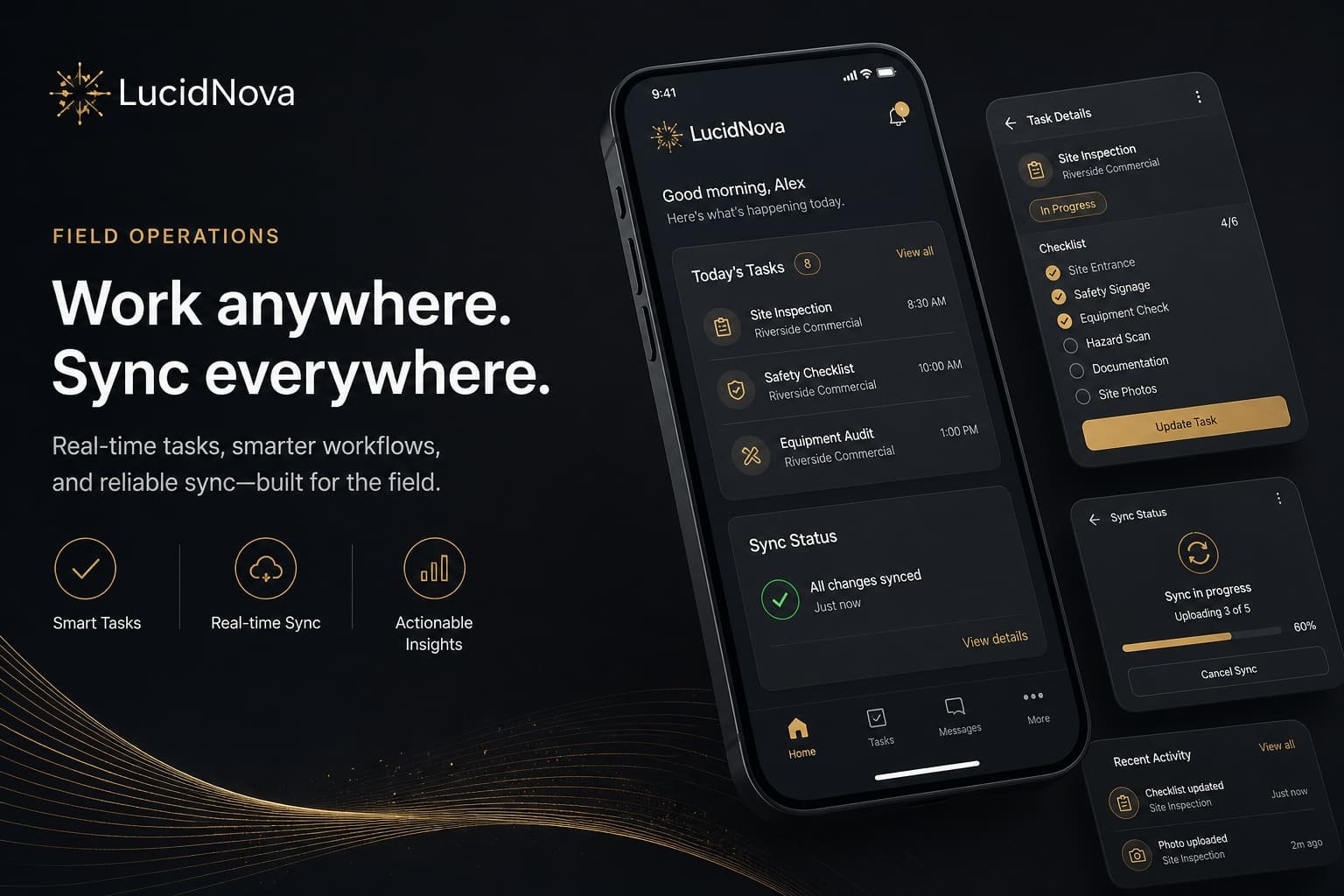
Task design beats feature lists
Field users open the app to complete a job, not to explore menus. Lead with today’s assignments, blockers, and proof steps. Hide secondary settings behind clear navigation. Every extra tap outdoors is a reason to abandon the flow and revert to unofficial channels.
Design for gloves, glare, and interrupted sessions. Save drafts locally. Resume where the operator left off. If training slides are required to understand sync icons, the UX has already failed.
- Prioritize the next action, not the full product map
- Surface blockers before nice-to-have details
- Capture proof at the step where disputes are common
- Make retry paths obvious when upload fails
Offline and sync as product promises
Offline support is not a technical footnote—it is a promise to crews. Decide conflict rules before launch: which fields can use last-write-wins, which facts are server-authoritative, and when a human must resolve a collision. Silent data loss destroys trust faster than a visible offline banner.
Architecture choices
Native, cross-platform, or hybrid should follow team capability, device requirements, and depth of platform APIs—not ideology. Cross-platform stacks can serve operational apps well when performance budgets and offline queues are designed intentionally from the first sprint.
Release habits for field apps
Field rollouts fail when updates ship like consumer apps: everyone at once, no monitoring, no regional pilot. Staged releases by region or crew, crash and sync monitoring as first-class signals, and a support path field leads will actually use keep adoption intact after go-live.
- Staged rollouts with a defined rollback plan
- Monitoring for sync failures and crash clusters by device/OS
- Support escalation that does not require operators to email attachments
- Release notes crews can read in two minutes
If the app only works on strong Wi-Fi, it is an office product wearing a phone costume.
How LucidNova builds field mobile
We design task flows, offline behavior, and release habits together—so the phone remains a reliable workplace on real sites, not only in demo environments.
Contact LucidNova Technologies · hello@lucidnovatech.com · Mumbai, Maharashtra, India