How to Evaluate a Software Development Partner
Evaluate a software development partner with discovery discipline, first-stage thinking, architecture ownership, security defaults, delivery transparency, and accountability after launch.
A partner pitch can look excellent and still be a poor fit. Slide decks rarely reveal how decisions are owned, how risk is surfaced, or what happens when production breaks after go-live. Those operating questions decide whether the engagement becomes an asset or an expensive dependency.
Evaluate partners the way you would evaluate a long-term operating relationship. You are not buying hours. You are buying judgment, delivery discipline, and the ability to leave you with a system your team can run.
Signals of a serious partner
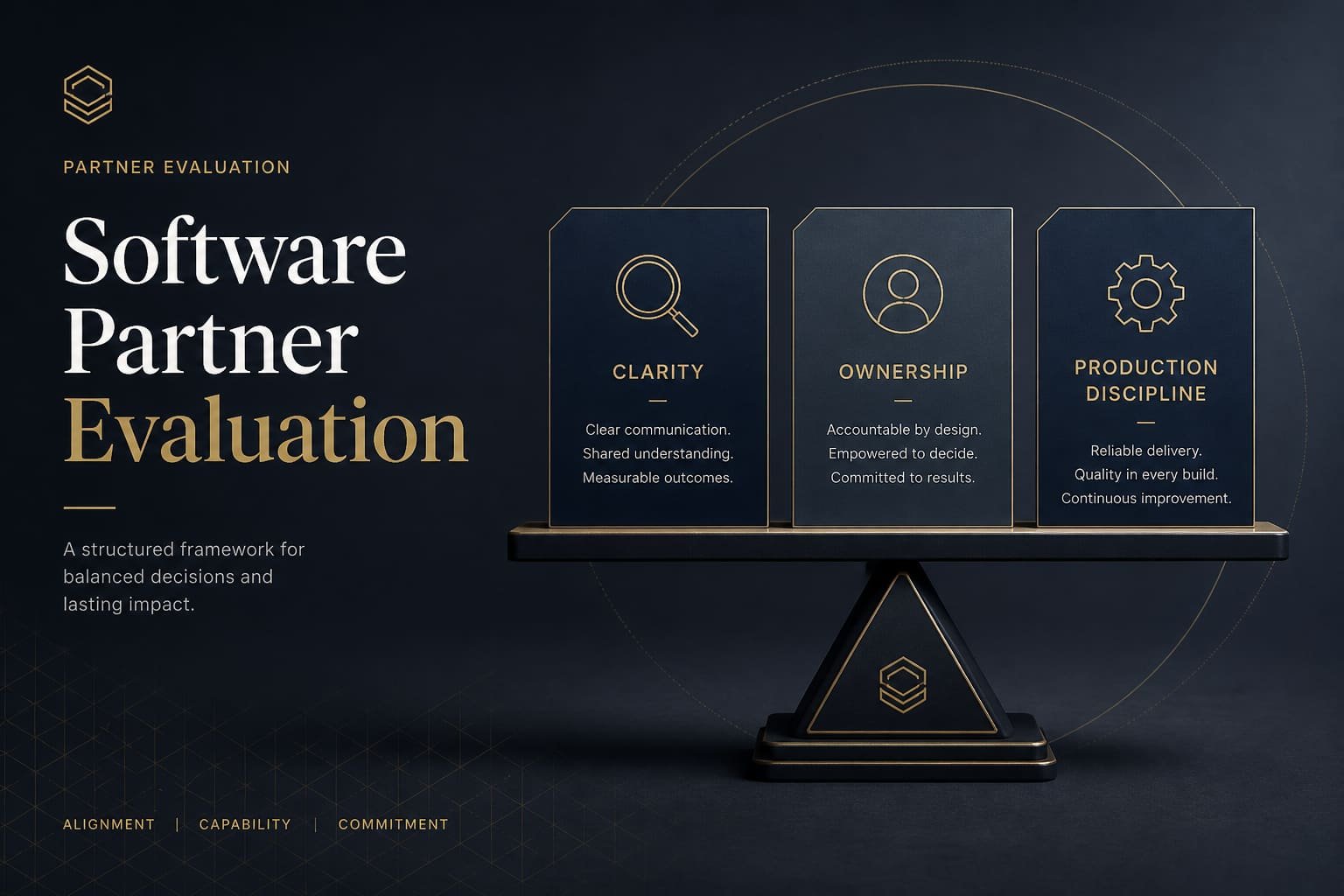
Serious partners behave like owners, not order takers. They push back on vague scope, recommend staged investment, and talk about production before aesthetics. They should be willing to say an engagement is not a fit when it is not.
- They ask about users, constraints, and failure modes before quoting a full program
- They recommend a first stage instead of an opaque all-at-once package
- They talk about security, logging, and maintainability as requirements
- They can explain who owns production issues after launch
- They are willing to say an engagement is not a fit
Questions worth asking in discovery
Good discovery questions expose how the partner thinks under uncertainty. Vague answers about “agile collaboration” are not enough. You want concrete ownership, trade-offs, and exit clarity.
- What would you refuse to build in v1, and why?
- How do you handle changing requirements mid-stage?
- Who is accountable when an integration fails outside business hours?
- What artifacts do we keep if the engagement ends?
- How do you communicate schedule risk before it becomes a surprise?
- How are environments, secrets, and access managed during delivery?
Evaluate delivery, not only design
Ask how releases are staged, how quality is verified before users see changes, and how rollback works. A partner who cannot explain rollout and support ownership is selling screenshots, not systems.
Request examples of how they document architecture decisions, hand off to internal teams, and train operators—not only how they wireframe. Design quality matters, but operability decides whether you still own the product six months after launch.
Commercial and fit signals
Pricing models reveal incentives. Fixed bids without discovery often hide contingency as change orders. Open-ended time and materials without stage boundaries can hide lack of plan. Look for structures that match investment to learned risk.
- Clear stage boundaries with decision points
- Transparent communication when scope or sequence must change
- Defined acceptance criteria tied to operational outcomes
- Honest assessment of what your team must own internally
Red flags
Guaranteed timelines without discovery, vanishing senior involvement after signing, and demos that cannot explain operating ownership are common warning signs. Equally concerning: proposals that treat security, data migration, and support as optional add-ons.
The right partner makes risk visible early—even when that means saying an engagement is not a fit.
What LucidNova optimizes for
We optimize for clarity before commitment and ownership after release. If that standard does not match how you buy software, it is better to know in the first conversation. A good partnership begins with an honest fit assessment—not a forced close.
Contact LucidNova Technologies · hello@lucidnovatech.com · Mumbai, Maharashtra, India