Generative AI in Enterprise Workflows: What Actually Works
What works for generative AI in enterprise workflows: start from costly work, ground answers, human review gates, evaluation sets, logging, and integration with systems of record.
Enterprise GenAI projects fail when they start with a model and hunt for a use case. They succeed when they start with a costly workflow and ask where language models reduce measurable effort without creating new risk.
The difference between a durable feature and a pilot that expires is operating design: permissions, grounding, review, evaluation, and an owner when quality drifts. Intelligence must be safe to act on—or clearly labeled as draft.
Use cases with durable ROI
Strong early use cases share traits: language-heavy inputs, checkable outputs, and humans still accountable for irreversible steps. Summaries with citations to source passages. Draft communications sent only after review. Knowledge answers limited to approved corpora. Structured extraction into fields the business already understands.
- Document summarization with citation to source passages
- Drafting customer or internal communications for human send
- Knowledge assistants limited to approved corpora
- Structured extraction into existing business systems
- Classification and routing that feeds named queues, not black boxes
Start from costly work, not from a model
Pick a workflow with measurable cost: slow document handling, repetitive drafting, or knowledge lookup that interrupts specialists. Then ask where models reduce effort. Success looks like shorter cycle time and fewer status chases—not higher chat volume in a sidebar nobody trusts.
If the workflow owner cannot see benefit in their metrics, the feature is still a demo. Define success before integration: what gets faster, what gets safer, and what still requires human judgment.
Non-negotiables for production GenAI
Grounding, evaluation sets, logging, permission-aware retrieval, and explicit escalation when the model is unsure. Without those, GenAI remains a conference demo. Production also needs change control: who may alter prompts, tools, or corpora—and how regressions are detected.
Prefer refusal over confident guessing when sources are thin. Users learn to trust systems that say “I cannot verify this” more than systems that invent plausible answers. Design empty states and escalation paths as first-class UX, not error handling afterthoughts.
Integrate with systems of record
GenAI creates durable value when it writes to fields and queues the business already operates—not when it lives in a detached chat window. Push structured outputs into CRM, ticketing, or document systems with the same validation you would require from a human clerk.
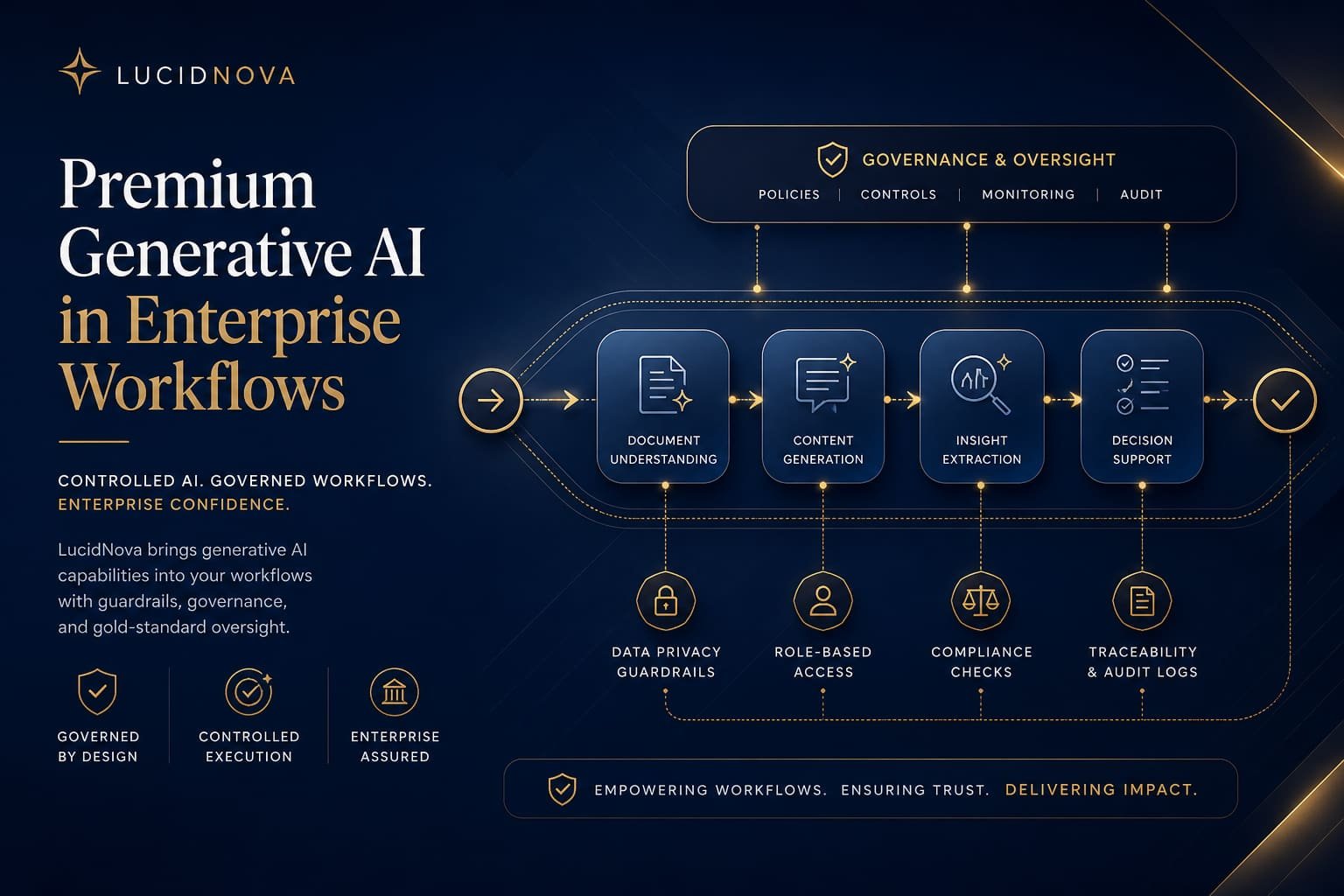
Governance that teams can follow
Governance should be operable, not a PDF shelf. Name excluded data classes. Define incident handling when answers leak, hallucinate dangerously, or bypass permissions. Assign an owner for model quality after launch—same as any production service.
- Who may enable new prompts, tools, or corpora
- What data classes are excluded from model context
- How incidents and quality regressions are handled
- How reviewers provide signal when drafts are edited
GenAI in the enterprise is useful when wrong answers are caught before they become wrong actions.
How LucidNova implements GenAI
We implement GenAI inside owned workflows—grounded, reviewable, measurable—so usefulness survives the pilot and teams retain trust in the systems they run.
Contact LucidNova Technologies · hello@lucidnovatech.com · Mumbai, Maharashtra, India