Where AI Automation Belongs in Business Operations
Where AI automation fits in operations: combine rules and models, require process owners and logging, roll out through shadow and review modes, and measure cycle time—not demo flair.
Operations leaders are right to be skeptical of AI theater. The future is not a single autonomous brain running the company. It is a set of well-scoped automations that remove repetitive work, improve consistency, and surface better decisions—inside processes someone owns.
Intelligent automation fails when it is purchased as a platform search for use cases. It succeeds when it starts with a costly workflow, clear success metrics, and a plan for what happens when the model is wrong.
From RPA to intelligence inside the process
Classic automation follows deterministic rules. AI automation interprets messy inputs—documents, messages, unstructured forms—and proposes actions or classifications. The winning pattern combines both: rules where certainty exists, models where judgment support is needed, and humans where irreversible impact is high.
Do not replace a working rules engine with a model because it sounds modern. Add models where variance in language or format makes rules brittle and expensive to maintain.
Operating model requirements
- A process owner who can change rules, review outcomes, and pause automation
- Logging that supports audits, debugging, and quality improvement over time
- Metrics tied to cycle time, error rate, rework, or cost-to-serve—not message volume
- A rollback path when model behavior drifts or vendor defaults change
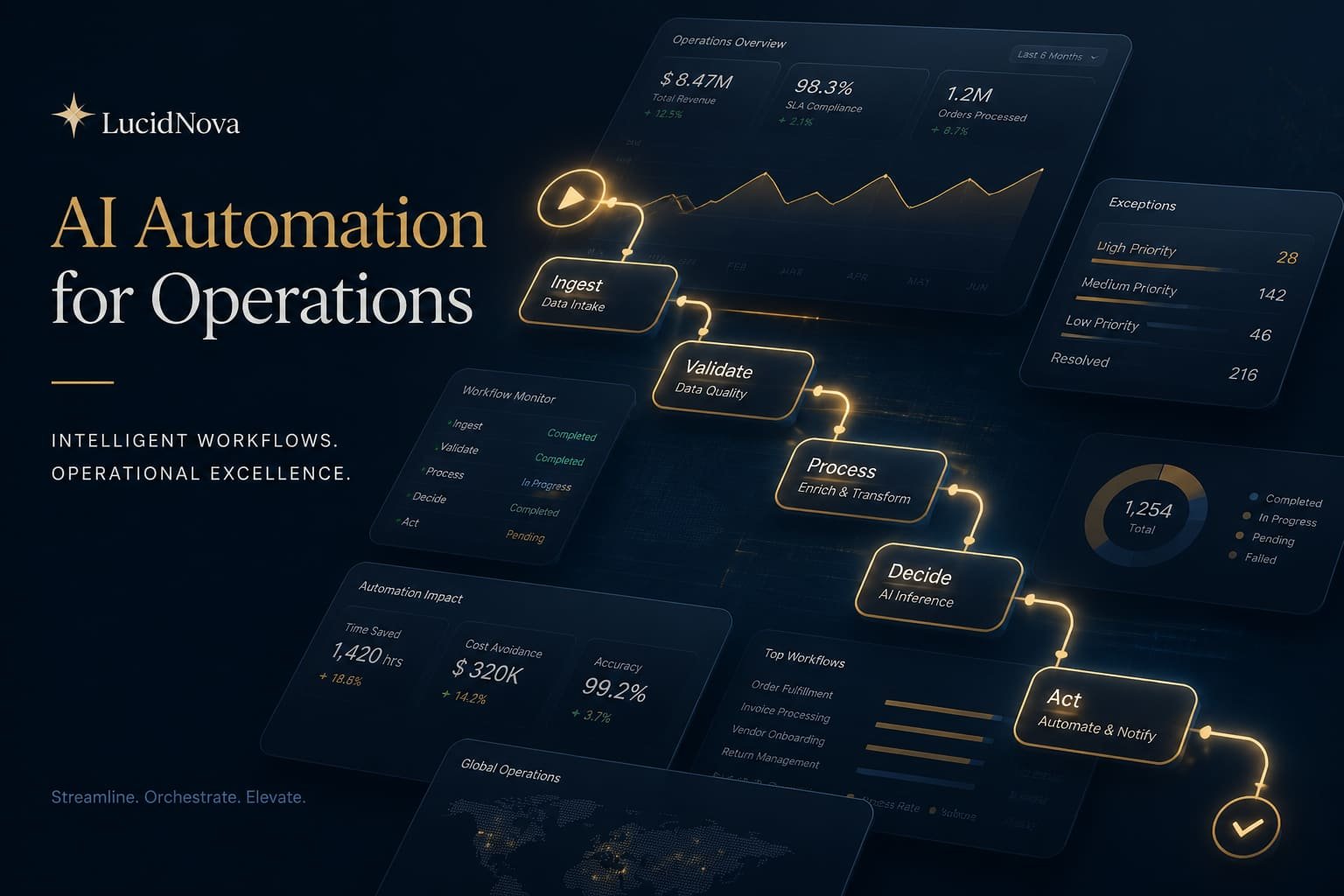
If nobody owns the automation after launch, quality will drift until the business stops trusting it.
Where AI belongs—and where it does not
AI belongs where language or documents create friction: intake, classification, summarization, routing suggestions, and drafting for human send. It does not belong as an unreviewed authority over money movement, safety-critical actions, or irreversible customer commitments.
The operating question is simple: if the model is wrong, how quickly does a human notice, and how hard is it to reverse the action? If you cannot answer that clearly, autonomy is premature—regardless of accuracy on a demo dataset.
A responsible rollout sequence
Treat rollout as an operating change, not a feature flag day. Each phase should produce evidence before expanding scope.
- Shadow mode: suggestions only, no side effects on systems of record
- Human-approved actions for a defined period with edit tracking
- Limited autonomy for low-risk steps with automatic escalation on low confidence
- Continuous evaluation against golden cases drawn from real operations
Maintainability after the pilot
Models, prompts, and corpora change. Assign an owner to review quality monthly, to approve prompt updates, and to re-run evaluation when vendors ship new defaults. Without that rhythm, accuracy drifts quietly until operators revert to manual workarounds.
Keep automation logic readable: rules for deterministic branches, models for variable language, humans for exceptions. Future engineers should understand the flow without reverse-engineering a black box.
LucidNova implements AI automation with this operating discipline so intelligence remains useful, reviewable, and maintainable inside real workflows—not as a pilot that expires when attention moves on.
Contact LucidNova Technologies · hello@lucidnovatech.com · Mumbai, Maharashtra, India